
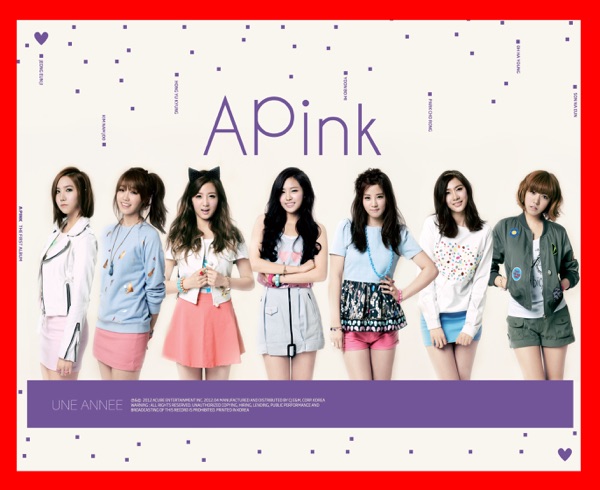
Une Annee
Apink
May 9, 2012 arrived like a small declaration. Apink issued Une Année as their first full-length album after a year of building an image that was at once innocent and deliberate. The group had debuted on April 19, 2011 and marked that anniversary two weeks earlier with the fan gift "April 19th". That song was written by leader Park Chorong and released on April 19, 2012. The release schedule itself made the record a statement. It closed the circle of the first year and opened the next, and the album title says it plainly in French. One year. A beginning that insists it is not a beginning.
Apink entered 2012 with momentum that was quiet but real. They had won their first music show trophy for "My My" in January 2012. They had worked with producers who already meant something in the world of K-pop. Names like Shinsadong Tiger and Rado appear on the credits. The group had toured internationally in March, playing to Korean diaspora and K-pop fans in Toronto. That tour performance and the modest accumulation of awards told two truths at once. They were not the biggest act in K-pop. They were an act that would not be hurried. Their sound was calibrated to last longer than a season.
The personnel lineup around this record carried a weight it would later carry differently. Une Année was the last Apink record issued while Hong Yookyung remained an active member of the septet. Her departure was announced the following year in April 2013 as a decision to focus on studies. That fact turns this album into a hinge. The record captures a seven-voice group on the threshold between trainee polished sweetness and the steadier, more public presence they would become. The singing here is still young. The phrasing is still learning to be compact and persuasive. But the harmonies have begun to deepen.
Musically the album stakes a modest claim. The title track "Hush" is a pop single with retro touches and swing phrasing that lets the group move into a slightly more grown-up register. Other songs on the record range from playful aegyo numbers to synth-tinged uptempo tracks and orchestral touches. The album was assembled in a moment when K-pop was widening its palette. Apink did not try to outrun that expansion. They joined it carefully. The aim was clear. Keep the group recognizable. Let the sound mature incrementally. Make the first full-length album feel like a map of possible futures.
The sessions for Une Année were reported to have taken place in 2012 at Cube Studio in Seoul. That is a straightforward fact and it locates the album inside the studio ecosystem of early 2010s K-pop. Cube and its partner labels were operating small, efficient recording machines. The album was produced by a roster rather than a single auteur. Rado, Hyu U (Hyuwoo), Shinsadong Tiger, Super Changddai, Kim Gun-woo, and collaborators such as Joker are named in credits. Production by committee was standard. It made a certain kind of clarity possible.
The sound of the record is built from familiar modern pop tools. Gated synths and bright lead synth lines sit beside percussive shoe-sounds on "Step" and a string-laced arrangement on "Bubibu" that the press described as orchestral. Several tracks foreground programmed drums with layered acoustic elements. Where Apink’s earlier records leaned toward pure bubblegum brightness, the engineering choices here allow vocal space. Lead lines and harmonies are placed forward in the mix. Reverb tails are short enough to keep the rhythm precise. The result is pop that feels breathable and tidy at the same time.
Collaborations shaped the album’s texture. Yong Jun-hyung of BEAST appears on "Sky High", credited in different sources either as Junhyung or Joker in his production capacity. Shinsadong Tiger and other established producers added songs that push Apink toward a retro-pop and synth-pop blend. The title track "Hush" was presented to the public with a music video released in early May and a dance-practice clip on May 14, 2012. Those visual releases are part of the record’s studio narrative. They connect recorded sound to staged movement. They show how the album’s vocals were intended to function live, tight and performative.
A few technical notes matter. The recording emphasizes ensemble clarity over dense layering. Vocals are double-tracked in places but leave room for single-voice moments. The closing track "Sky High" adds rap textures over a gated-house rhythm and lyrical string lines. On songs such as "I Got You" and "Sky High" the producers introduced a harder synth edge than Apink had previously used. Reportedly, the album’s vocal sessions were focused and quick. The aim was to translate a live-friendly sound into a recording that would read well on music shows and in fans’ headphones. That tension between stage and studio gives Une Année its shape.
Une Année (Intro)
The album opens on a short, deliberate statement. The intro names the record and the occasion. It is barely a minute long and it frames the album as a ceremonial return. The track’s textural choice is spare. It moves like the clearing of space before a group of singers step forward. It places voice first and then lets instrumentation quietly declare the seasonal sweep the album promises. As an opener it asks the listener to listen for continuity rather than reinvention.
HUSH
The title track is the record’s commercial heart. Co-produced by Rado and Hyu U, the song leans on a retro-pop lilt and a tight brass-like synth that punctuates the chorus. Lyrically the song is a confession of shy attraction where the singers murmur and insist at once. Vocally the members take turns on lead lines while the ensemble softens the edges in the chorus. The choreography and the music video, released in early May, emphasize syncopated hand and shoulder movements that match the song’s offbeat accents. In the album sequence "Hush" sits second after the intro and asserts the record’s tonal center. It asks the group to be lovable and exact.
Cat (고양이)
"Cat" is a compact aegyo piece, built to be cute without flattening the vocal delivery. The melody is light and sprightly. Composition credits name Kim Gun-woo, and the lyricist MayBee is reported to have written the words. The arrangement favors acoustic rhythmic accents and bright, trebly synths that mimic mewling lines in the vocal phrasing. In the album flow it follows the more public-facing "Hush" and reasserts the youthful persona Apink carried in their early career. The result is immediate and functional. It was created to be performed and to charm.
April 19th (4월 19일)
Placed near the album’s middle, "April 19th" is both a fan gift and a narrative marker. The song was released digitally on April 19, 2012 to celebrate the one-year anniversary of Apink’s debut. Park Chorong is credited with writing the lyrics. The track is warmer and more direct than some of the production-heavy moments on the album. It uses straightforward pop-ballad conventions to convey gratitude. Within the full-length the track functions as an intimate pause. It tells the listener who the record is for.
BUBIBU
"Bubibu" is one of the record’s more ambitious arrangements. Press descriptions at the time emphasized an orchestral sweep combined with acoustic instruments and synth. The single version released later in July 2012 was chosen for follow-up promotion by fan vote on Mnet’s website. That decision says something about the song’s democratic appeal to Apink’s audience. Musically the chorus is built around a strong melodic hook. The sonic choices give the track a breadth that aims to translate well both on stage and in headphone listening. In the album sequence "Bubibu" works as an expansive wedge between the personal "April 19th" and the percussive forward motion of "Step".
STEP
"Step" foregrounds rhythm in a literal way. The track includes percussive elements described in contemporary coverage as shoe-sounds layered into the beat. The producers here balance a light synth bed with clipped percussion and an airy chorus. The effect is kinetic. Vocally the song keeps lines short and rhythmic, asking the singers to snip syllables precisely. In the album’s arc "Step" reintroduces motion after the breath of "Bubibu". It pushes the listener toward the record’s more playful second half.
BOY
"Boy" is a short, bright pop tune with a catchy repeating motif. The instrumentation is streamlined. The arrangement places a bouncy bass line beneath bright trebles and accented snaps. Lyrically the song occupies the familiar terrain of adolescent affection. It holds little theatrical ambition. In the context of the album it functions as a palate cleanser. Its brevity and pop directness restore attention for the album’s closing pair.
I GOT YOU
This track marks a moment where producers known for harder synth textures leave a clear imprint. Shinsadong Tiger, Joker and Kim Tae-joo are reported to have worked on the song. The mix brings forward a taut, slightly more aggressive synth timbre than Apink had prominently used before. The lyrics compare the dizzying feeling of attraction to a riddle and to movement through traffic lights. Performance-wise the record asks the members to cut phrases against the beat. As the penultimate track it raises the energy and sets up the final push to "Sky High".
Sky High (하늘 높이) (feat. Joker / Yong Jun-hyung)
The album closes with a collaboration. Yong Jun-hyung, credited in various releases as Junhyung or Joker, contributes a rap and is associated with the song’s production in some credits. The track layers gated-house synths, a brisk four-on-the-floor pulse, and lyrical strings that suggest lift. The chorus sings about flying higher and further. As an album closer the song works as a programmatic statement. Where the intro declares a year passed, the closer claims ascent. The presence of an external male vocalist points outward. The group sounds as if they are looking past themselves toward a broader pop stage.
As a sequence Une Année is compact and economical. The intro and closer provide bookends that state intent and motion. The album alternates between performance-ready singles and quieter personal moments. The middle of the record is the warmest part. "April 19th" is the heart. The placement of "Hush" early secures a commercial identity while leaving room for the group to display a range of moods. The ordering privileges flow over contrast. The record never seeks to shock. It asks to be understood as an evolving statement from a group that wanted to remain identifiable while expanding its tools. That modesty shapes the listening arc. The album moves like a group learning to breathe in public and to hold a note beyond a single season.
The initial reception of Une Année was measured and steady. The album peaked within the top five on the Gaon Album Chart, where it reached number four during May 2012. Its lead single "Hush" charted on the Korean charts and received regular promotion on music programs beginning in mid-May. The music video was released in early May 2012 and a dance practice video followed on May 14, 2012. Those promotional artifacts shaped the public’s experience of the record. They amplified the relationship between recorded songs and televised performance.
Fans responded with the kind of attention that matters for careers rather than for headlines. A follow-up single, "Bubibu", was chosen for additional promotion by fan vote on Mnet and released as a single in July 2012. The choice shows two things at once. It shows that the record created multiple touchpoints fans could rally around. It also shows the group’s early cultivation of a participatory audience. Commercially the album sold in the low tens of thousands domestically during 2012. Reported cumulative sales by Gaon and aggregated sales trackers place the figure in the low-to-mid twenties thousand range for the year. Those numbers are not arena-filling. They are sufficient to mark Apink as a durable mid-tier act on the rise.
The album’s cultural impact was incremental rather than revolutionary. In 2012 K-pop was expanding. Idol groups were experimenting with synth textures and retro gestures. Apink’s contribution was conservatism that knew how to move. Une Année did not seek to rewrite pop grammar. It worked on the principle that consistent identity could be a form of influence. The album consolidated Apink’s public persona. It showed the group could headline music programs, sustain a set of singles, and maintain a bond with fans through deliberate gestures like "April 19th".
Over time the album has been read as a transitional document. It is the last record with seven active members and the moment when the group’s sonic palette widened beyond pure bubblegum brightness. The songs have continued lives in performance and in fan memory. Tracks such as "Hush" and "Bubibu" have been anthologized in Japanese releases and later reappearances. The record matters less as a flashpoint than as a hinge. It is not forgotten. It occupies a clear place in Apink’s arc. It records the moment they turned one year into a deliberate career path.
SOURCES
- Wikipedia: "Une Année" - Album entry and release details.
- Wikipedia: "Apink" - Group history and member changes.
- Soompi articles: "A Pink Releases Music Video for 'Hush'" and "A Pink Releases Dance Practice Video for 'Hush'" (May 2012) - reporting on visual releases and promotion.
- Apple Music: Une Année album listing and regional release metadata.
- Gaon Chart reporting and contemporary summaries (Allkpop and weekly Gaon listings) - chart peak and weekly placement.
- Apink Japan Official Site discography entry for Une Année - tracklist and release information.
- Apink Fandom / community discography pages - track credits and collaborator listings.
- BestsellingAlbums.org and aggregated sales trackers - reported cumulative sales figures for 2012.