
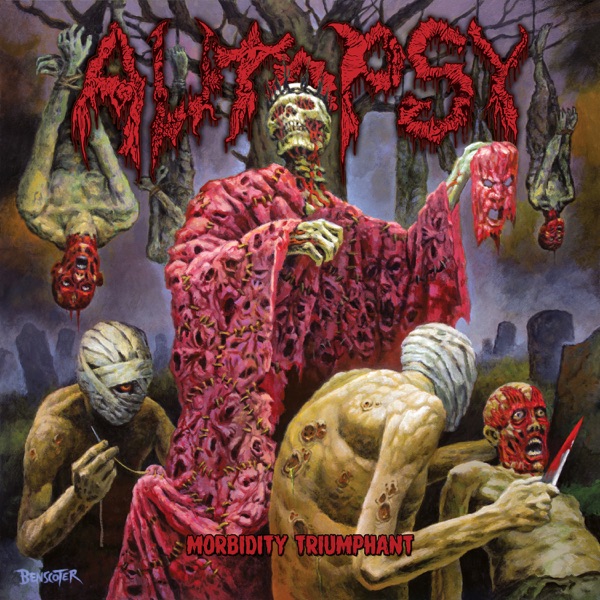
Morbidity Triumphant
Autopsy
Autopsy returned to the studio with hunger, not nostalgia. After eight years away from a full-length, the band that first split the skull of American death metal in 1989 came back intent on making music that felt lived in, filthy, and immediate. The interval between Tourniquets, Hacksaws and Graves (2014) and Morbidity Triumphant (released September 30, 2022) was not empty. It held tours, EPs, the steady work of keeping a sound alive, and the slow reknitting of a band that has always sounded like a single organism. This album arrived as a deliberate continuance of a lineage that begins with Severed Survival and Mental Funeral and moves through the reunion-era records Macabre Eternal and The Headless Ritual. The intent was not to recapture a past moment. The intent was to prove that the past can still move like a fist.
The most tangible change before the record was the lineup shift at bass. Greg Wilkinson joined the band in 2021 after years playing with Chris Reifert in Static Abyss. Wilkinson is credited as the sole writer of one track on the album. His presence matters because Autopsy has always been a rhythm-first band. The band credited songwriting across the four members, with Chris Reifert, Eric Cutler, and Danny Coralles carrying the lion’s share of material and Wilkinson contributing a new bottom end. That redistribution of authorship altered the band’s dynamics in small but decisive ways. The grooves became thicker. The tempo choices felt less like a demonstration and more like a digestion.
The cultural and musical context of 2022 shaped the record in quiet, unavoidable ways. Old-school death metal had been through a revival in the 2010s and found itself crowded by younger bands and retro trends. Autopsy could have done either of two things. They could have retreated into museum-piece replication. Or they could have leaned into the original sickness that made them singular and updated it just enough to remain dangerous. Instead they did the latter. The result is an album that sounds like a direct line from the band’s early obsessions with horror cinema and Bay Area punk to the present. The record’s conceit is simple and unpitying. It wants to make you feel rotten and awake at the same time.
The album title, Morbidity Triumphant, came after the artwork. The painting by Wes Benscoter provided the mood. The band reportedly gave him only a few song titles and themes and let his imagination take over. The cover arrived as a provocation. The title followed and fit. The band has often worked this way. A visual first. A song as a reaction. The process makes the record feel less like a plan and more like a seizure. That shape is audible on every track.
The record was laid down at Opus Studios in Berkeley, California, during March and April 2022. The sessions were engineered and produced by Adam Munoz, a long-time Autopsy collaborator. According to the album credits, Munoz handled recording and mixing while the band is credited as co-producer. The work at Opus is immediate in the sound. It is not immaculate. It is not polished until it loses teeth. The drums sit forward and raw. The guitars are abrasive but framed enough to reveal their counterpoint. The mix preserves odd textures without indulging them.
The band tracked live elements and kept arrangements lean. Chris Reifert recorded drums and vocals. He remains the band’s axis. His drums are propulsive and stubborn. They are not designed to be pretty. They are designed to push flesh off bone. Danny Coralles and Eric Cutler provide the twin-guitar violence the band has relied on for decades. Their interplay on this record favors sudden, violent exchanges of lead and rhythm over long, virtuosic flights. Greg Wilkinson’s bass is present and physical. He is credited with writing the album’s second track. The instrumentation choices return Autopsy to the middle ground between doom and punk-tinged death metal. On this album, the band accepted space where older records might have preferred clutter.
On the technical side, the record was mixed to emphasize weight not sheen. The mastering was completed by Ken Lee at Ken Lee Mastering in Oakland in April 2022. The mastering choices favor density and low-end presence. High frequencies are sharp but not glassy. The mastering lets riffs breathe and drums thud without flattening nuance. Those decisions pushed the album toward a sound that is gnarled and immediate. It sounds like it was recorded in a room with windows open just enough for the outside world to be heard but not to disturb the rot.
Visual and cinematic elements were part of the studio thinking. The band released a lyric video for "Skin by Skin" in August 2022 and a gory, practical-effects music video for "Knife Slice, Axe Chop" on September 21, 2022. The video for the latter was created with Rabidog Films and The Butcher Shop for effects. Those pieces were not afterthoughts. They were part of the album’s communication strategy. The videos extended the record’s DNA into filmic territory and affirmed what the studio sessions wanted to declare: this album is meant to be felt with the eyes as well as the ears.
Stab The Brain The opener throws you in. It is short, violent, and unyielding. The song begins without ceremony and keeps its focus on blunt force. The drumming pushes forward like a blade. Reifert’s vocal delivery is immediate and viscerally theatrical. Musically the track establishes a pattern the album will return to: abrupt tempo changes, a willingness to shift from grind to lumber in a single phrase, and guitars that squeal while still keeping the riff simple. As an opener it does what an Autopsy opener should do. It clears space in the head and prepares the listener for sustained discomfort.
Final Frost This track opens with feedback and a slow, foreboding shuffle before ripping into faster sections. The arrangement lets the guitar textures breathe. Here the band leans into doomier territory, but it never lets the slowness become inert. The chorus sections snap back with faster, punk-tinged aggression. The contrast is a device Autopsy has used since the early records. On this album it feels sharpened. The song demonstrates how the new lineup treats dynamics as the principal instrument.
The Voracious One The groove in this song feels almost primitive. It is a patient, predatory track that lives in a mid-tempo churn before erupting into jagged lead work. Coralles and Cutler trade off lines that sound like two maniacs arguing over the same riff. The solos are brief and jagged. Lyrically the song fits the album’s obsession with hunger and consumption. It stands as a reminder that Autopsy’s terror is often anthropological. They describe violence as a force that eats shape and meaning.
Born In Blood A doomy opening gives way to a d-beat propulsion. The track rides that collision between doom and punk across its runtime. Reifert’s drumming holds the sections together with a metronomic cruelty. The bridge slows to a viscous crawl. The band demonstrates a confidence here. They know how to build tension without showing off. The payoff is in the feeling of a machine learning how to breathe.
Flesh Strewn Temple This is one of the album’s most unflinching numbers. Riffing is thick and almost slavish in its devotion to mid-paced doom. The guitars create a procession that is hard to avoid. It is a song that wants to stay in the chest. In the context of the album it acts as a center of gravity, a place where the record’s slower impulses gather and spin like a blade in soft tissue.
Tapestry Of Scars This track is notable for the way Reifert plays with cadence and voice. At moments his delivery pulls close to spoken menace. The lyrics, vivid and clinical, map injury as autobiography. Musically the song moves through abrupt time shifts and vocal asides that make the listener feel unmoored. It is one of the record’s more theatrically unsettling moments. The production keeps the voice slightly lower in the mix so the words hit like a hand.
Knife Slice, Axe Chop Short and vicious. The single and its accompanying music video accentuated the album’s public arrival. The track compresses Autopsy’s tendencies into under three minutes of pure assault. The guitars bite and the drums sprint. For sequencing it acts like a jolt between slower passages and the denser second half. The video, created with practical gore effects, confirmed the song’s role as the record’s in-your-face provocateur.
Skin By Skin This was presented with a lyric video ahead of the album release. The riff that opens the song is dirgelike and menacing. The arrangement moves between slow, Sabbath-tinged heaviness and bursts of frenzied guitar work. Reifert’s vocal performance is charged with a performer’s relish for the grotesque. The song is credited to Eric Cutler as songwriter. In the context of the album it functions as one of the clearest statements of the record’s marriage of doom atmospherics and death metal violence.
Maggots In The Mirror A brief track that cuts like a jag. At under two minutes it acts as the album’s purgation. The tempo careens. The guitars buzz like insects. In placement it is a palate cleanser that works by assault rather than relief. It prepares the listener for the extended violence of the closing pair.
Slaughterer Of Souls This song is one of the album’s more dynamic pieces. It alternates heavy, almost dirge-like passages with quick, cutting death metal runs. The guitar work between Cutler and Coralles is particularly lively. The track is patient when it needs to be and furious when it chooses to be. It is a statement of how the album balances restraint and release.
Your Eyes Will Turn To Dust The closer opens with slow, crawling riffs and then moves into an outbreak of speed before settling back into a groovy stomp. The title line is delivered with menacing clarity. The song closes the record with a final reminder of the band’s intent. The album ends in motion. It does not resolve neatly. It leaves the listener with a pressure in the ears and a persistence in the mind.
The sequencing of the album is deliberate. The record alternates between blunt, short assaults and longer, atmospheric devotions to doom. That alternation creates a rhythm of attention. The listener is pushed, then allowed to stare into the wound. The mid-album center contains the record’s heaviest, slowest material and then the closing quarter turns back toward speed and panic. The flow feels like an arc of a body in motion. The songs are arranged to maintain tension by way of contrast. Autopsy did not attempt a linear narrative. They built an experience of accumulation. Each track functions as an incision or stitch, and taken together they produce the feeling of a living thing dissecting itself.
The album was released by Peaceville Records on September 30, 2022. Critical reception was largely favorable across specialist outlets. Reviews praised the record for its raw, organic production and the band’s confident songwriting. Outlets such as Pitchfork, Blabbermouth, Metal Injection, and others characterized the album as a strong late-period statement from a band that had seldom lost its edge. Listeners responded positively on platforms like Bandcamp where the album was made available in high-resolution formats. The release was accompanied by a steady stream of press pieces and the Knife Slice, Axe Chop music video that amplified the record’s presence in metal communities.
Commercially the album did not register as a mainstream chart smash. There are no widely reported major chart positions on Billboard or the Official UK charts tied to the release. The record’s impact was therefore cultural more than commercial. It reinforced Autopsy’s position within the death metal conversation and provided touring momentum into late 2022 and beyond. The band supported the album with dates and festival appearances where possible. The videos and singles kept the album visible to both older fans and newer listeners who had been sampling the revival of old-school death metal.
In the years after release the record has been spoken of as part of Autopsy’s consistent late-career output rather than as a radical reinvention. It is often grouped with Macabre Eternal, The Headless Ritual, and Tourniquets, Hacksaws and Graves as part of the band’s post-reunion run. Critics and fans noted that the album reaffirmed what the band had been doing well since reuniting: combining mid-paced doom with violent death metal bursts and an unapologetic appetite for gore imagery. Its legacy is modest in grand commercial terms and significant within the subculture. It did not rewrite metal history but it reinforced a lineage.
Influence is less about chart placement and more about example. Younger bands that take cues from Autopsy’s marriage of doom and death metal cited the album as a recent instance of how that sound can be kept alive without simple imitation. The record’s raw production and the band’s refusal to tidy their textures provided a template for artists who wanted weight and grit rather than perfect sheen. In that sense Morbidity Triumphant contributed to a continued thread in heavy music that prizes atmosphere and physicality. It arrived as proof that Autopsy’s sickness remained contagious.
SOURCES
- Peaceville Records / Autopsy Bandcamp listing for "Morbidity Triumphant" - official release details and credits.
- Metal Archives entry for "Morbidity Triumphant" - detailed credits, recording dates, songwriting credits, and formats.
- Pitchfork review of Autopsy "Morbidity Triumphant" - critical analysis and context.
- Metal Injection review and coverage - contemporary critical response.
- Blabbermouth interview/features with Chris Reifert - band history and comments about style and continuity.
- MetalHeads Forever and other press coverage detailing the "Knife Slice, Axe Chop" video release and credits.
- Overdrive and other announcements regarding the "Skin by Skin" lyric video release.
- Various publications and reviews cited above (Metal Temple, Metal Talk, GRIMM Gent, LoudandProud) for track-level commentary and reception.